
How to Save Prompts in ChatGPT: The Complete Workflow Guide
ChatGPT doesn't save your prompts for you. Here's the definitive guide to saving, organizing, and instantly reusing your best ChatGPT prompts — without the copy-paste grind.
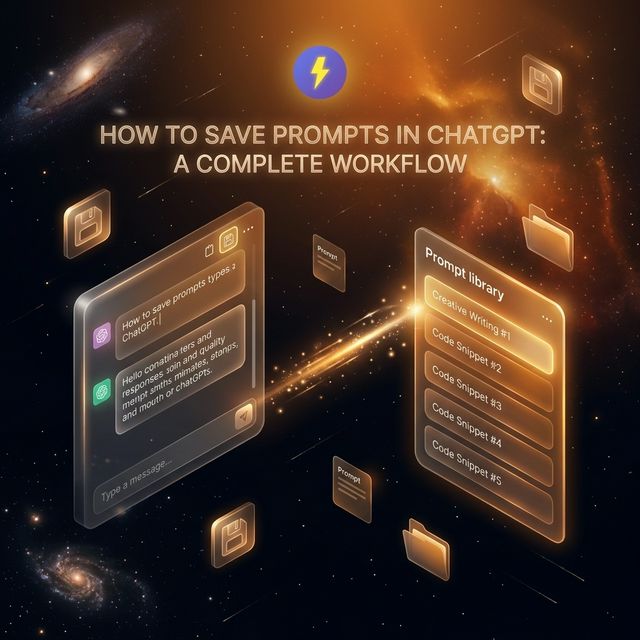
Here's a scenario you've almost certainly lived:
You spend 20 minutes crafting the perfect prompt in ChatGPT. The output is exactly what you needed. You feel the satisfaction of AI productivity clicking into place. You close the tab and get on with your day.
Three weeks later, you need the same output for a similar task. You open ChatGPT. Blank input box. You scroll desperately through your chat history. You find the rough version — from the fourth attempt, not the final one. The output is mediocre.
You just experienced Prompt Amnesia — and it's one of the most common productivity leaks in AI-assisted work.
This guide fixes that permanently.
Why ChatGPT Doesn't Save Your Prompts (And Why That's a Problem)
Let's be clear about what ChatGPT does and doesn't offer:
What ChatGPT gives you:
- Conversation history (the full back-and-forth)
- Chat search (by title, not by prompt content)
- Shared links for conversations
- Memory (limited, for ChatGPT Plus users)
What ChatGPT does NOT give you:
- A way to save a specific prompt as a reusable template
- A searchable prompt library
- Keyword shortcuts to reinsert common prompts
- Variable fields for template customization
- Any form of prompt organization or categorization
This isn't an oversight. ChatGPT is a conversational interface, not a prompt management system. Expecting it to manage your prompts is like expecting Google Docs to manage your calendar events. They're different tools for different problems.
The problem is: millions of users are trying to use ChatGPT as both. And the productivity cost is enormous.
The True Cost of Not Saving Your Prompts
Let's quantify what prompt amnesia actually costs you:
- Average time to recreate a lost prompt: 8–20 minutes (depending on complexity)
- Frequency for a regular AI user: 3–5 times per week
- Weekly time cost: 24–100 minutes
- Annual time cost: 20–80+ hours
That's potentially two full work weeks per year spent recreating prompts you already wrote once.
At an average knowledge worker's hourly rate, this is a meaningful financial cost — on top of the pure frustration of losing quality work.
The 5 Ways People Try to Save ChatGPT Prompts (And Their Limitations)
Before getting to the best solution, let's survey the common workarounds and their real-world limitations:
1. Notion or Google Docs
The workflow: Copy prompts into a doc. Organize by section. Search by Cmd+F.
The limitation: Every use requires tab-switching from ChatGPT, manually finding the prompt, copying, switching back, pasting. This adds 30–60 seconds per prompt use. At 20 uses per day, that's 10–20 minutes of pure friction daily.
2. Apple Notes / Standard Notes
The workflow: Dump prompts into notes. Tag them loosely.
The limitation: Notes apps are designed for linear writing, not structured retrieval of frequently reused templates. Search is unreliable for exact prompt recall.
3. Text Expander / Clipboard Managers
The workflow: Use Alfred, TextExpander, or a clipboard manager to store and trigger prompt snippets.
The limitation: These tools weren't built for AI prompt workflows. No variable support tailored for AI templates. No AI-platform integration. Clunky setup for prompt-specific use cases.
4. Browser Bookmarks
The workflow: Save the ChatGPT conversation containing a good prompt. Bookmark it.
The limitation: You're bookmarking a full conversation, not the prompt. Finding the specific prompt inside it still requires scrolling. And when the conversation is overwritten? Gone.
5. Memory / Intuition
The workflow: You remember your prompts. You're good at this.
The limitation: You aren't. Nobody is. Prompt amnesia is universal. The human brain is not optimized for exact-wording recall.
The Right Solution: A Dedicated Prompt Manager
The correct tool for saving ChatGPT prompts is purpose-built for exactly this job: a prompt manager browser extension that:
- Lives inside your browser (no tab switching)
- Triggers prompts directly from the ChatGPT input field
- Supports variable templates for flexible reuse
- Searches your library by fuzzy text match
- Stores everything locally (no privacy exposure)
FlashPrompt is the leading tool in this category. Here's how it works in practice.
How to Save Prompts in ChatGPT with FlashPrompt
Step 1: Install FlashPrompt
Download FlashPrompt from the Chrome Web Store or Edge Add-ons. No account creation required. The extension activates immediately after installation.
Step 2: Save Your First Prompt
Three ways to save:
Option A — Selection save (from any webpage):
- Highlight any text (your prompt draft, a template, existing text)
- Use the FlashPrompt selection-save control
- Name it, assign a trigger keyword (e.g.,
-email-reply) - Done
Option B — Save from the ChatGPT input box:
- Type your prompt into ChatGPT
- Before hitting Enter, click the FlashPrompt icon that appears in the input area
- Select "Save this prompt"
- Assign a trigger keyword and save
Option C — Open the FlashPrompt popup:
- Click the FlashPrompt browser icon
- Click "+ New Prompt"
- Paste your prompt, assign a trigger, save
Step 3: Use Your Saved Prompt
Next time you need this prompt in ChatGPT:
- Click into the ChatGPT input box
- Type your trigger keyword (e.g.,
-email-reply) - FlashPrompt's overlay appears showing your match
- Press Enter — the full prompt expands instantly in the input box
No tabs. No copy. No paste. Just your prompt, exactly where you need it, in under 1 second.
Building a Systematic ChatGPT Prompt Library
Saving individual prompts is step one. The real productivity multiplier is a structured library you can navigate at speed.
The Category Prefix System
Organize your prompts with single-letter prefixes that act as instant category filters:
-e-: Email (writing, replying, declining)-c-: Code (debugging, refactoring, documenting)-w-: Writing (blog, copy, social media)-r-: Research (summarizing, comparing, analyzing)-m-: Meetings (agendas, summaries, follow-ups)
When you type -c- in the trigger field, your library instantly shows only code-related prompts. No scrolling past irrelevant options.
Adding Visible Placeholders to Your Prompts
Static prompts have limited reuse value. Variables unlock the real power:
Summarize the following in [3/5/10] bullet points,
targeting a [technical/non-technical] audience:

[CONTENT]
FlashPrompt inserts the saved template into the current text field. Replace each bracketed placeholder manually, review the finished prompt, and then send it.
Your Starter Prompt Library for ChatGPT
Here are 12 essential saves to start your ChatGPT prompt library:
-e-reply→ Respond professionally to the following email: [EMAIL]-e-decline→ Politely decline the following request without burning the relationship: [REQUEST]-e-follow→ Write a brief, non-pushy follow-up to: [ORIGINAL_EMAIL]
Writing
-w-outline→ Create a detailed outline for a blog post on [TOPIC] targeting [KEYWORD]-w-edit→ Edit the following for clarity and conciseness. Do not change the tone: [TEXT]-w-hooks→ Write 10 compelling opening hooks for content about [TOPIC]
Code
-c-review→ Review the following code for bugs, security issues, and style: [CODE]-c-doc→ Write JSDoc documentation comments for the following function: [FUNCTION]-c-explain→ Explain the following code as if to a junior developer: [CODE]
Research
-r-sum→ Summarize the key points from the following: [TEXT]-r-compare→ Compare and contrast [A] and [B] across [DIMENSIONS]-r-pros→ List the top 5 pros and cons of [TOPIC]
Start with these 12. Within one week of active use, you'll understand which ones you use most and can refine them accordingly.
The Compound Effect of Prompt Saving
Here's what people don't anticipate: saved prompts get better over time.
Your first version of -e-reply might produce decent outputs. But after using it 40 times, you notice it always misses a certain polish. You edit the saved prompt — add a line about tone, or a specific instruction about length.
Now every future use benefits from that refinement. Your library becomes smarter. Your outputs get better. The compound interest of prompt engineering pays you back every single day.
This is what separates casual ChatGPT users from people who achieve genuinely extraordinary results with AI. It's not talent. It's system.
Privacy Considerations When Saving Prompts
One concern worth addressing directly: your prompts may contain sensitive information. Client names, product details, internal processes, proprietary formulas.
When you save prompts with FlashPrompt, they are stored in Chrome's local storage — sandboxed on your device. FlashPrompt does not operate a cloud service that stores your prompt data. There is no server receiving your templates.
For professionals who handle sensitive information, this is the only acceptable approach. Cloud-based prompt managers — even reputable ones — create data exposure risk that most users haven't thought through carefully.
Conclusion: Build the Habit, Reap the Rewards
Learning how to save prompts in ChatGPT properly is one of the highest-ROI habits in modern knowledge work. It takes discipline to save in the moment — but the payoff compounds.
Every prompt you save is 10–20 minutes you'll never spend recreating it. Every template you refine is a quality improvement that scales across every future use. Over months, your library becomes a genuine competitive asset.
FlashPrompt makes this habit frictionless. It lives in your browser, activates in the ChatGPT input field, and turns saving into a two-click action. It's a one-time purchase — meaning you invest once and benefit every day, forever.
Stop losing your best prompts. Start saving them.
Get FlashPrompt — pay once, own it forever.
Ready to supercharge your AI workflow?
Join thousands of professionals using FlashPrompt to manage their AI prompts with lightning-fast keyword insertion and secure local storage.